COI Tracking Software That Catches Lapses Before They Become Claims
Every vendor's certificate of insurance is valid until the day it isn't. Entuitive Workforce collects and verifies COIs at onboarding, then monitors every expiry date — so a lapse triggers an alert, not a liability transfer.
Why manual COI tracking fails
A certificate of insurance is a snapshot: it proves coverage existed on the day it was issued, nothing more. The policy behind it can be cancelled mid-term or narrowed at renewal while the certificate sits in an inbox, still asserting coverage that no longer exists. A spreadsheet records what was true at collection; it does not watch what happens next.
The failure is asymmetric: tracking COIs manually costs a few admin hours per week, while one missed lapse costs whatever the incident costs — because an uninsured vendor's claim has a way of finding the property owner or general contractor who let them on site. Our analysis of contractor insurance lapses covers how often coverage quietly disappears between annual checks.
How COI tracking works on Entuitive Workforce
Collect
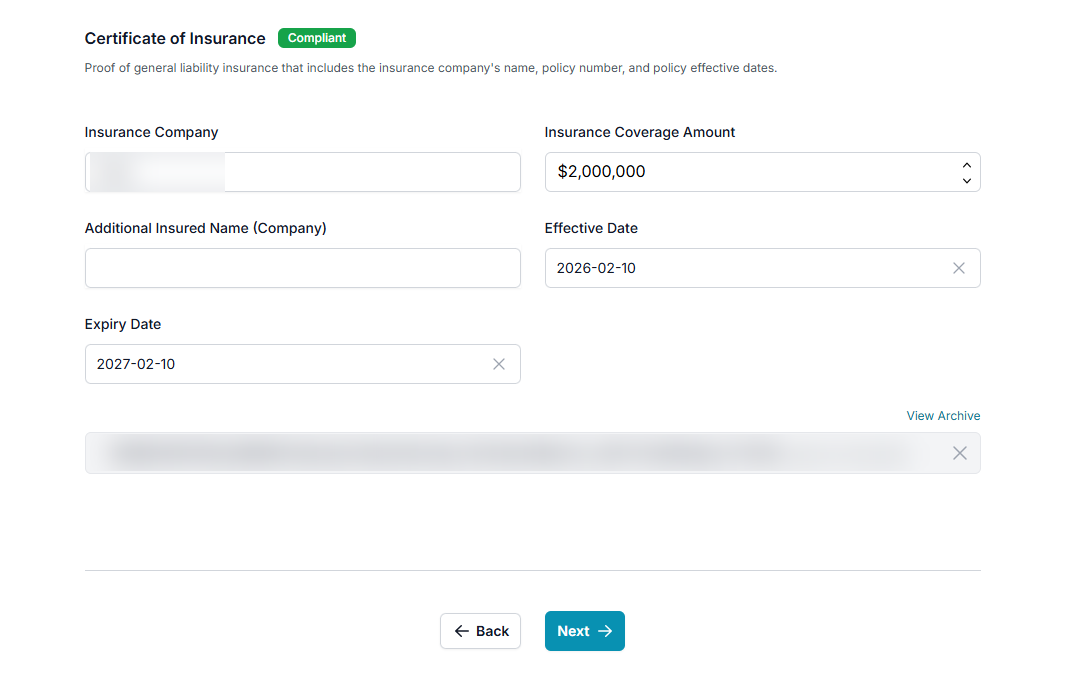
Vendors upload their certificates through a guided onboarding flow — completed in minutes, not weeks, with no email chains and no PDF folders.
Verify
Each COI is checked against the requirements you set: coverage types, limits, and validity dates. Non-conforming certificates are flagged before the vendor starts work, not after.
Monitor
Every certificate is tracked against its expiry date, continuously. Approaching expiries trigger alerts to the vendor and to your team, with time to renew before a gap opens.
Prove
Every verification is logged, so an auditor, insurer, or lawyer asking "did you check?" gets a timestamped answer in minutes.
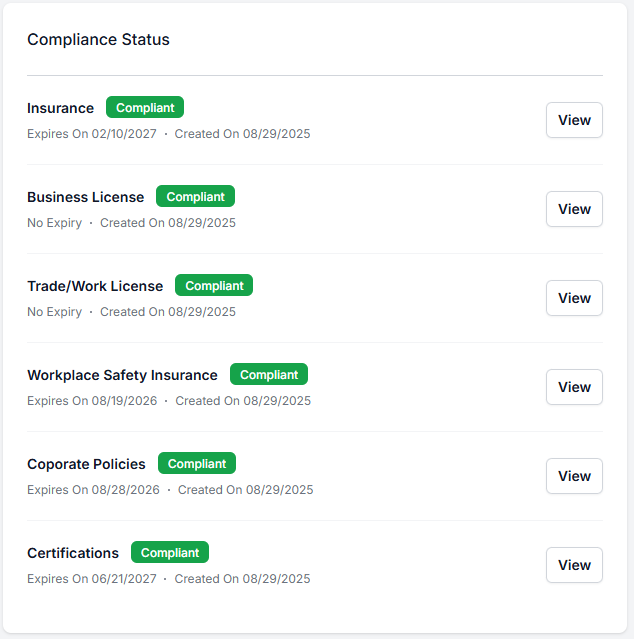
An actual vendor's compliance status inside Entuitive Workforce.
What COI tracking software should verify
A certificate on file is not the same as coverage confirmed. A working COI program verifies the coverage types your contracts require (general liability at minimum, plus auto or umbrella where relevant), the limits your risk team has set, the policy period against today's date, and workers' compensation clearance alongside the COI — WSIB in Ontario, provincial WCBs, CNESST in Quebec, and state programs in the US. Entuitive Workforce holds all of these in one vendor record and routes each one to our compliance team for review, so "compliant" means the whole file was checked by a person, not just uploaded.
Who uses COI tracking software
Commercial property managers and REITs
Hundreds of vendors across a portfolio means certificates expiring every week — live COI status per vendor per property replaces the annual binder check. Seasonal vendors carry the tightest deadlines — snow removal contractors are verified before the first storm.
Construction firms
Subcontractor COIs and workers' comp clearances verified before site access, documented for OHSA due diligence.
Healthcare organizations
Contractor documentation held to audit-grade standards, because that is the standard their own auditors apply.
Insurance brokers and carriers
Policyholders who verify vendor COIs are better risks — fewer surprise claims and cleaner underwriting at renewal.
Skilled trades and independent contractors
One COI and WSIB clearance, uploaded once and shared with every property manager or GC that requires it — instead of re-sending the same documents by email each time a client asks.
Beyond the certificate — verification at the gate
A verified COI in the database does not stop an uninsured worker at the door. Tap n' Go QR badging carries compliance status to the site itself: workers scan in, and the badge answers whether the person and their employer are currently compliant. COI tracking plus site-level verification means the record your office verified is the same one checked at the gate. See digital badge verification.
COI tracking software — frequently asked questions
What is COI tracking software?
COI tracking software collects certificates of insurance from vendors and contractors, verifies them against the hiring organization's requirements, monitors expiry dates continuously, and alerts both sides before coverage lapses. It replaces spreadsheet-based certificate management with live compliance status.
Why is tracking certificates of insurance important?
A COI only proves coverage existed on its issue date. Policies can be cancelled or changed mid-term, and an expired certificate discovered after an incident can shift the claim to the property owner or general contractor. Continuous tracking closes the gap between annual certificate checks.
How does automated COI tracking work?
Vendors upload certificates during onboarding, and each one is reviewed against the coverage types, limits, and dates you require before the vendor is marked compliant. From there, every certificate is monitored to its expiry date, and approaching expiries trigger alerts with time to renew.
Can COI tracking software verify workers' compensation too?
Yes. Entuitive Workforce tracks workers' compensation clearance alongside COIs — WSIB in Ontario, WCBs in other provinces, CNESST in Quebec, and US state programs — in the same vendor compliance file.
How long does it take to onboard vendors?
Onboarding takes minutes, not weeks: vendors receive a document request, upload their certificates through a guided flow, and verification starts immediately. A typical contractor file is completed in about 25 minutes.
Is there a free trial?
Yes — Entuitive Workforce comes with a free 30-day trial, and you can book a demo to see COI tracking configured for your own vendor list.
See your vendor list with live COI status
The demo runs on your own vendor list and real certificates, not a canned dataset — with a free 30-day trial included.